
 Newtown Square is home to many excellent schools, organizations and programs dedicated to enriching the lives of our youth. This month, we shine a spotlight on Talk School. Located in the Corporate Center on Campus Blvd, Talk School is a school unlike any other. It is not defined by rows of desks or rigid schedules. Instead, its classrooms are filled with children learning to speak, read and connect in ways that once seemed impossible. For these students, ages 5 through 21, every word spoken is an accomplishment, and every sentence a doorway to independence.
Founded in 2002 by parents searching for better options for their children with Autism and severe communication challenges, Talk School was built on a simple but powerful belief: no child should be silenced by their disability. Today, it remains the only full-time program in Pennsylvania devoted to school-age children with profound speech and language disorders.
Kristen Tabun, EdD, serves as Head of School. “Talk School serves a unique community — children with severe speech and language differences who often find traditional classrooms overwhelming and those in need of services beyond what their school district provides,” Kristen explained. “Our mission is ambitious yet clear: to combine intensive therapy with rigorous academics, creating an environment where students can thrive socially, emotionally and intellectually.”
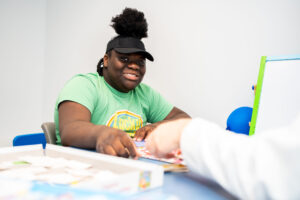 Their impressive 16,000-square-foot facility features thoughtfully designed classrooms, occupational, art and music therapy spaces, fitness rooms, speech therapy rooms with suspended equipment, a multi-purpose room for family socials and the end-of-year annual show, along with beautiful outdoor play, gathering and gardening areas.
Unlike other schools that separate therapy from learning, Talk School seamlessly weaves both together. Each child is seen as a whole person, with intertwined challenges and strengths. Autism, Apraxia or neurological differences are not treated as labels, but as starting points for individualized programs that address communication, literacy and development simultaneously. Kristen further explained by saying, “The collaboration between classroom teachers and speech therapists is paramount. That integrated nature of our work is a really unique feature that distinguishes us.”
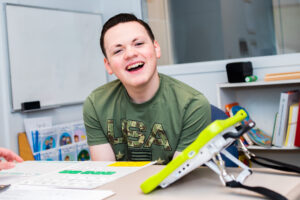
 At the heart of Talk School’s approach is the Association Method, a phonics-based, multisensory curriculum originally developed over 50 years ago at the Central Institute for the Deaf. Using a carefully sequenced process, students progress from individual sounds to words, then sentences and ultimately to complex language.
This method has been life-changing for children with severe Apraxia, a motor-planning disorder in which individuals know what they want to say, but their brains struggle to coordinate the mouth and tongue movements needed to form words, Autism and other disorders, such as traumatic brain injuries, once thought to impede speech. With consistent practice, many students who were once considered nonverbal have gone on to read, write and express themselves verbally for the first time.
Yet Talk School recognizes that communication is more than mechanics. Through DIR/Floortime, staff focus on nurturing relationships and building trust. The simple joy of a shared smile or playful exchange becomes the building block for complex thought, problem-solving and meaningful expression.
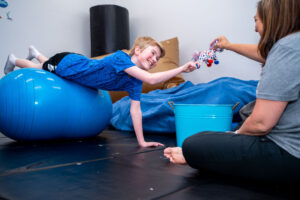
 For many students, communication challenges are intertwined with sensory processing difficulties. To address this, Talk School integrates sensory integration therapy, helping children organize and respond to sensory input — sight, sound, touch and movement. This leads to calmer behavior, stronger motor skills and better focus.
Kristen said that, unlike traditional schools, parents and families are essential partners in the educational process. “We want our families to be involved as much as possible,” she explained. “Parents receive training and ongoing mentoring to implement strategies at home.” The school also stresses the importance of identifying hidden medical issues — from gastrointestinal pain to sleep disorders — that can quietly undermine learning. In this way, Talk School’s approach is comprehensive, leaving no stone unturned.
The admissions process reflects the school’s commitment to finding the right fit. Families begin with an information session, followed by a screening and evaluation. A week-long trial placement allows children to experience the classroom firsthand, easing anxieties about transition. From there, staff and parents decide together if Talk School is the right environment for growth.
For Talk School families, progress is measured not only in academic gains but in life-changing moments. A child calling “Mom” for the first time. A student reading aloud during circle time. A teenager learning to self-advocate. These are not small victories — they are breakthroughs that often reshape families and futures. Scott and Sue Ellen Bledsoe have been sending their daughter to Talk School for the past five years and said that she has made incredible strides. “The dedication to advocacy for our daughter, the Talk School staff shows every day, rises above the rest,” they said. “Knowing she has an intelligent, kind and extremely hard-working team in her corner is worth more than gold.”
In a world where communication is too often taken for granted, Talk School stands as a reminder of the profound power of words — and the dedication of the teachers and staff, combined with the resilience of the children who work so hard to find them.
Talk School is located at 6 Campus Blvd, Newtown Square. For more information, call 610-356-5566 or visit their website at TalkInc.org.