
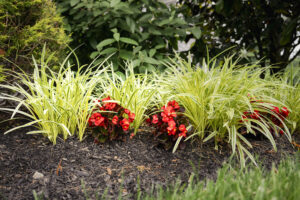
 Proper care of your new plantings is crucial to ensuring their health and long life. Please refer to these guidelines:
Water- A few long and deep waterings weekly are much better than frequent light waterings. To check if watering is needed, remove some mulch from around the new plant- the soil should be damp, but not muddy or crumbling and dry. Allow the soil time to drain between watering- this promotes air penetration into the soil, which is key for root development.
Mulch- Helps to moderate fluctuations in temperature and moisture. A layer of 1-2” of double ground bark mulch should be maintained on your plantings. This will also suppress weed growth. Mulch decomposes with time, adding organic matter to your soil. Mulch helps with water and air penetration in the roots of your plants.
Pruning- Determines the shape and habit of your woody plant material. Deadwood should be removed whenever present. Contact us for expert pruning of live growth to maintain shape and habit and to ensure that pruning is done at the proper time of year for your plant.
Fertilizer- Helps supplement nutrients not available in your native soil. Contact us to determine and apply appropriate fertilizer blends at the right time of year for your plants.
Watering Directions
When to Water- All newly planted material; trees, shrubs and flowers should be watered at least four times a week.
- If a lack of rain or drought conditions exists, water them even more.
- Do not rely solely on rainfall.
- Do not water when the temperature is freezing.
How to Water- Water trees and plants from ground level at the base of the plant.
Water in the early morning before the sun becomes strong (before 9:00am or later in the evening. (After 8:00 pm)
- For individual plants where sprinklers or soaker hoses do not apply, remove the nozzle from the end of the hose and water for 60 seconds, with the water turned down to ¾ flow (to prevent blasting away the soil and mulch) each day.
- Use a soaker hose or drip lines in newly established beds or rows of evergreen trees or shrubs. These hoses are efficient water savers and will cut down on your time in the garden. Also, now available at most home and garden centers, digital automatic timers, which you can just set and forget.
Fertilization
Fertilizing is done after the plant has been installed for 6 to 12 months. An excessive amount of a complete fertilizer can cause serious injury and may result in the death of the plant. Leave fertilization to the professionals.