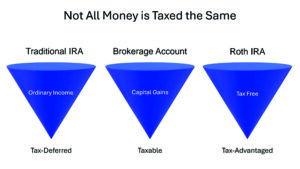
 A Roth conversion, as a general overview, is a process by which funds are withdrawn from your tax-deferred IRA, you pay income taxes on the distribution, then deposit the funds into a tax-free Roth IRA. Whether the funds are used for retirement income or passed on to heirs as part of your legacy, your Roth account will grow tax-free. When designing a Roth conversion strategy, the end goal is typically the same: to create the maximum amount of wealth for the IRA owner and/or the IRA owner’s heirs.
How much of your tax-deferred IRA should you convert and when? Roth design options include lump sum, a specified amount over a period of years, grossing up your current tax bracket, equalizing your effective tax bracket, or random year and random amount conversions.
Roth conversion results don’t always follow a logical pattern. Your retirement expenses will determine how much cash flow is needed. Cash flow can be sourced from multiple accounts (ordinary income, capital gains, tax-free). Where your cash flow comes from may or may not affect the success of your Roth conversion.
Variables that impact the success or failure of Roth conversions are often overlooked. Where is the money coming from to pay the tax bill? Are the rates of return and life expectancy numbers for the IRA owner and heirs reasonable? What is the IRA owner’s effective tax rate? What additional Medicare Parts B and D surcharges will be incurred under different conversion scenarios? What are the marginal tax rates of the IRA beneficiaries? Are state income taxes involved? What about stock market downturns? Should potential long-term care expenses be considered? Is legacy planning a priority? Will estate planning be an issue?
It’s not easy for consumers to educate themselves on the nuances of Roth conversions. Conversion numbers will not be accurate if using only a handful of variables. Incomplete or oversimplified advice can lead to mistakes. And since Roth conversions are irreversible, any mistakes cannot be undone.
If your goal is to create the maximum amount of wealth for you and/or heirs, a properly designed Roth conversion strategy could help bring clarity to a subject that is much more challenging than people often realize.
Financial Planning and Advisory Services are offered through Prosperity Capital Advisors (Prosperity”), an SEC registered investment advisor. Registration as an investment advisor does not imply a certain level of skill or training. The CP Welde Group and Prosperity are separate entities. Prosperity does not provide tax or legal advice.