
 First things first: no Virginia, there was no Sandy Flash. However, that fictitious character was modeled on an actual bandit, James Fitzpatrick, the self-styled Captain Fitz. He was a strong and handsome local boy from southern Chester County who lived during the American Revolution. He joined the American army, but like many boys raised on the frontier, he did not take well to military discipline and apparently was whipped for some minor infraction. That was enough army life for him; he deserted and went home to work on the local farms.
He was pursued at home and went on the lam, beginning his short career as a highwayman. He is reported to have given the British local information which let them surprise and defeat Washington’s army at Brandywine. Fitz robbed and whipped local travelers on the roads. He stored his stolen goods in the cave that formerly existed at Castle Rock.
A Springfield boy recalled that a man stopped by the Fox Chase Tavern in Newtown to have his horse shod. The stranger asked if the boy knew about Captain Fitz. The boy admitted that everyone was afraid of him. The stranger flipped a coin to the boy and told him to tell his friends that he had met Captain Fitz. The most colorful Newtown connection is in Ashmead’s 1884 History of Delaware County. In that account, Fitz walked into the Square Tavern with both pistols drawn, called for a drink, downed it while still holding one pistol, then said “Good day, gentlemen” and backed out of the door, jumped on his horse, and disappeared … in a flash!
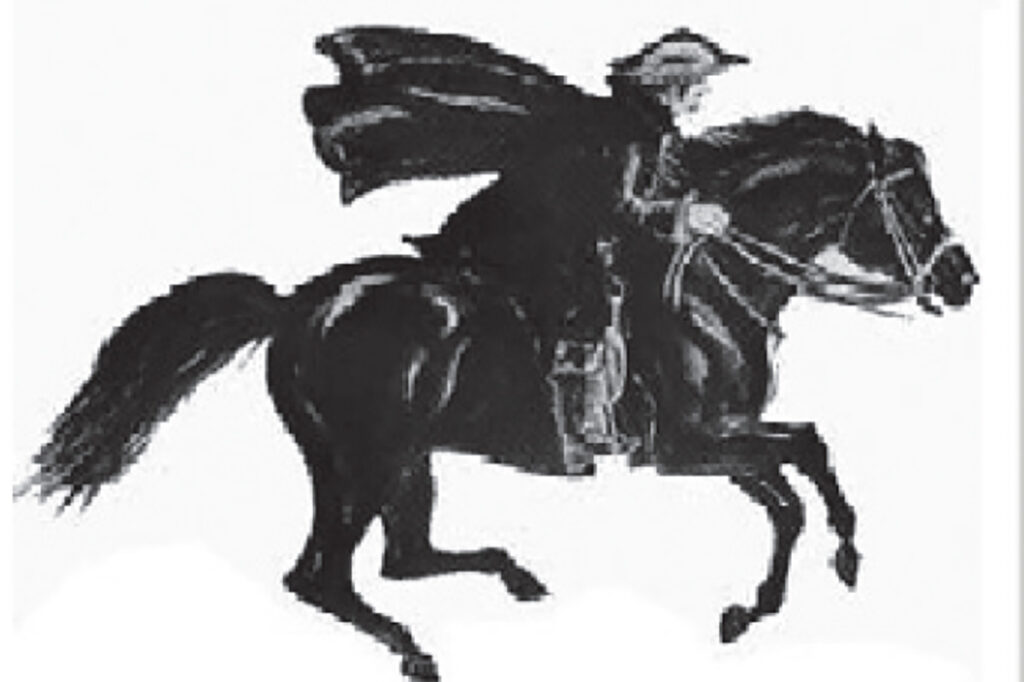 The British left Philadelphia in June of 1778, and Fitz lost his protection. A warrant was issued for his arrest; and at a farmhouse in Edgmont (now the Edgmont Shopping Center), Captain McFee and his maidservant, Rachel Walker, tackled Fitz, tied him up and turned him over to the authorities. He was promptly tried, convicted, and “hung by the neck until dead” in Chester.
In 1866, Bayard Taylor wrote “The Story of Kennett”, weaving a story that included some of the exploits of Fitz, but it was assigned to a fictional Sandy Flash. In 1922, Captain Clifton Lisle, took Taylor’s villain, and devoted a whole book to him: “Sandy Flash, the Highwayman of Castle Rock”. All of the larger-than-life stories that had grown up around Captain Fitz were re-told in detail. The real Fitz merged with the fictitious Flash, and in the 21st century, who knows the difference? Just you and me.
For more history on Newtown Square, Delaware County, and membership information, please visit our website at nshistory.org.
