
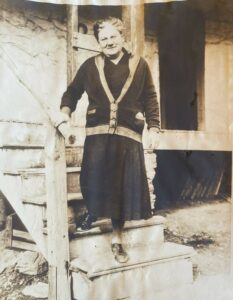
 In 1931, the Countess, a “broad-beamed woman of middle age, with hazel eyes behind pince-nez glasses, and greying hair pulled back from her high forehead,” could be seen almost daily walking on Bryn Mawr Avenue from her home off of Malin Road just over the line in Radnor, crossing underneath the railroad bridge and continuing up to West Chester Pike. She then turned right and headed on to the post office. Postmaster Charles Hanley recalled that she would visit every day, looking for news from the old country. Clutching her mail, she would then walk back to the ancient farmhouse where she was living, a round trip of about 3 1/2 miles.
 In an unheated stone home with no running water, she would fetch water, chop her own wood, and tend to her crops, her pigs and a lone Jersey cow. Local children called her the Pig Lady. She bathed in the creek that runs through the property. At night, by candlelight, she worked on finishing her book about her parents’ stormy relationship. Newtown Square was a sleepy country village in those days, so seeing the youngest daughter of one of the greatest Russian authors was a novelty. A Countess! In Newtown Square!
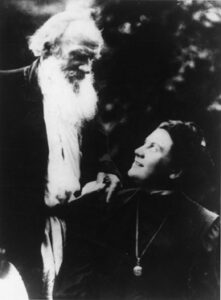
The Countess was Alexandra “Sasha” Tolstoy, the youngest daughter of Leo Tolstoy, the author of “War and Peace” and “Anna Karenina.” Until her father’s death in 1910, Sasha was his secretary, companion, and later executor of his works. Then came 1917. Sasha was “a wealthy thirty-two-year-old Russian countess who lived on a three hundred-and-thirty-acre country estate that included a model farm stocked with blooded cattle.” But in 1917, Vladimir Lenin and the Bolsheviks seized power. When the blood had dried, the workers of the world had united – and were ready to throw off their chains. But if you were on the wrong side of that divide, a countess, life would change.
 Sasha was accused of anti-Soviet activities and imprisoned. Later released, she threw herself into helping the Russian people, organizing schools, an orphanage and a hospital for the poor. Life was bad under Lenin, but much worse when Stalin succeeded him. Given the opportunity to travel abroad, Sasha did so in 1929, at age 45, fleeing Russia, and eventually arriving in rural Radnor township. Why did a wealthy Countess take up subsistence farming in a dilapidated farmhouse in Radnor? Tune in next month to find out!
For more history on Newtown Square, Delaware County, and membership information, please visit our website at: https://nshistory.org/