
 After the Revolution, Delaware County did not exist. Chester County was huge, and its county seat, situated along the Delaware River, was equally inconvenient for everyone. That problem was solved in 1789 when the eastern townships were split off to form Delaware County, which kept that inconvenient county seat – the city of Chester. Chester County located its new county seat at the small crossroads village of Turks Head. Naming the town for a swinging sign over the local tavern was not dignified enough for a county seat, and so they changed the name of the town to West Chester.
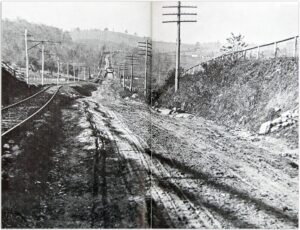
 The next change needed was to get a road in place for travel from Philadelphia. In 1793 the legislature directed that a State road be laid out from Philadelphia through West Chester and further west. It was surveyed, and over the next several years a narrow two-lane road was built over the hilly Chester County countryside. Roads were still simply dirt surfaces, widened and flattened to accommodate two lanes of traffic. By 1800, the initial work was done as stagecoaches began to run over the new road.
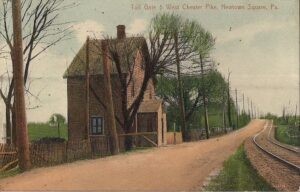
Travel over dirt roads was dirty and dusty in good weather, and impassable after rain and snow, leaving deep ruts. Demand for better roads led to new ideas—in 1848 the Philadelphia & West Chester Turnpike Road Company was formed to construct a 60’ wide hard-surfaced road from Philadelphia to Newtown Square, using hemlock planks to create a durable surface. The first president of the 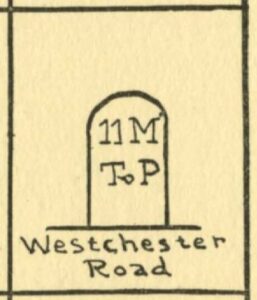 Company was the aptly named William Rhoads of Newtown Square. Planks did not have a long life, and so by 1867, the road was repaved with crushed stone. Each mile was marked with a distinctive stone marker by the side of the road—a milestone. Travelers paid one cent per mile for each horse or mule, with heavy wagons and coaches paying more. Tolls were collected at toll booths along the way. Tollgate #5 was just east of the intersection with Media Line Road.
Longtime resident Jan Elston recalled her mother’s tales from childhood—when her mother would ride to town in the family carriage, they would pass the milestone that said “10 M to P”. She would turn to her mother and say “That’s a long time to hold it.”
In 1918 the State of Pennsylvania paid the Turnpike Company for its rights and took control of the road, discontinuing the hated tolls and toll booths. It was the end of the era of private toll roads in Delaware County.
For more history on Newtown Square, Delaware County, and membership information, please visit our website at: https://nshistory.org/