
America’s 250th birthday offers an opportunity to reflect on the places that stood at the dawn of our nation. In Newtown Square, 29 of the township’s oldest homes quite literally witnessed the birth of the United States. Today, we take a closer look at the history behind two of our surviving “witness” homes.
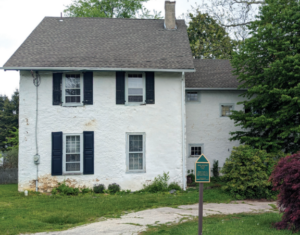 The John Hunter House
The John Hunter House at 405 College Avenue predates 1776 and stands today as a silent reminder of the generations who lived through the struggle for independence and helped shape the early history of the area.
Built in 1722, the stone home was constructed by John Hunter, an immigrant who arrived in Newtown Township that same year alongside the grandfather of General Anthony Wayne. Remarkably, Hunter was already 55 years old when he settled in the area. Although he spent only the final dozen years of his life here, he made a lasting impact on the growing community. He acquired land, established a farm and helped erect St. David’s Episcopal Church, where he was later buried after his death at age 67.
His story serves as a reminder that opportunity and purpose are not limited by age. During those twelve years, Hunter laid the foundation for a family legacy that would continue in Newtown Square for generations. His descendants became deeply woven into the fabric of the community, including Reese Hunter Jr., who began operating a feed outlet in 1917. That business eventually evolved into Newtown Square Home Supply, a familiar name to many longtime residents.
The land that once formed John Hunter’s original farm remained in family hands for years. One of his descendants, Warren Hunter, lived on property that had once been part of the early homestead, maintaining a connection to the family’s roots nearly two centuries after the house was built. Although the home has undergone alterations over the years, many of its original features survive. Behind its stucco exterior are substantial 18-inch stone walls that have stood for more than three centuries. Original flooring remains in several rooms, and the house contains five fireplaces, hand-carved mantels and original window sills. These details offer a glimpse into the craftsmanship and building techniques of colonial Pennsylvania.
The John Hunter House is recognized as one of Newtown Square’s historic resources and is included in inventories compiled by the Newtown Square Historical Society and Newtown Township. It joins a remarkable collection of early structures that tell the story of the township’s development from a small colonial settlement into the thriving community it is today.
As America commemorates 250 years of independence, historic houses such as the John Hunter House take on added significance. Buildings constructed before 1776 are often referred to as “witness houses” because they were standing when the Declaration of Independence was signed. Long before the arrival of automobiles, electric lights and modern conveniences, the walls of the John Hunter House sheltered families who experienced the uncertainty and excitement of a young nation taking shape.
More than 300 years after its construction, the John Hunter House remains one of Newtown Square’s oldest surviving landmarks. It is not merely an old building, but a tangible link to the people who settled the area and to the extraordinary events that transformed the thirteen colonies into the United States of America. As the nation celebrates its semiquincentennial, this enduring home reminds us that history is not found only in textbooks. Sometimes, it stands quietly on a neighborhood street, having witnessed it all.
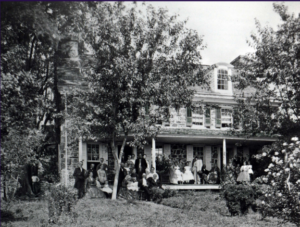 The Samuel Caley House
Long before the United States declared its independence, Samuel Caley was establishing roots in Newtown Township. By 1737, the Caley family had settled in the area, and around 1768 Samuel Caley built the handsome stone residence that still stands today along Caley Road. More than two and a half centuries later, the Samuel Caley House remains one of Newtown Square’s treasured historic landmarks and a living witness to the events that shaped our nation.
Built in the Dutch Colonial style, the house began as the centerpiece of an 80-acre farm that supported generations of the Caley family. Although additions and alterations have been made over the years, the home retains much of the character that connected it to colonial Pennsylvania. Some of the original wood flooring and woodwork survive, along with large first-floor fireplaces and smaller ones upstairs, reminders of a time when heat and family life revolved around the hearth.
Like many homes in southeastern Pennsylvania, the Caley House found itself caught up in the turmoil of the American Revolution. During the British occupation of Philadelphia, military raiding parties ventured into the countryside in search of food, livestock, and supplies. On September 19, 1777, the Queen’s Light Dragoons arrived at the Caley farm and confiscated property valued at an astonishing £3,100. The loss represented a substantial
financial blow to the family and illustrates the hardships endured by ordinary residents living in the path of war.
The Caley family continued to farm the property throughout the eighteenth and nineteenth centuries. Around 1800, additions and major changes expanded the house to meet the needs of a growing family. Between 1830 and 1850, the distinctive gambrel roof and third floor were added, giving the structure much of its present appearance. The original dining room was later enlarged with a stone addition to accommodate a very different chapter in the property’s history.
From 1886 until 1946, the estate belonged to Pennsylvania Hospital. During those years, the property was adapted for institutional use and served as a facility for patients suffering from mental illness. Men and women stayed there for relatively short periods before being transferred or replaced by others. The house thus became part of the long and evolving history of mental health care in the Philadelphia region.
Evidence of the property’s agricultural past can still be found outside. On the rear patio stands the remains of a summer kitchen, where traces of original hardware survive in the massive fireplace. Behind the house sits an old shed believed to have served as a blacksmith shop, a reminder of the practical trades that supported farm life in early Newtown Township.
Today, the Samuel Caley House at 3523 Caley Road is recognized as one of the more than 100 historic sites identified by the Newtown Square Historical Society. Stewart and Mare Spahr have owned the residence since 1977. “We were looking for old homes with character and a nice yard,” Stewart said. “Our home had exactly what we were looking for and a rich history that we both appreciate.” While traffic and neighborhoods have replaced much of the surrounding farmland, the old stone residence endures. Its walls have witnessed colonial settlement, revolution, agricultural
prosperity, changing approaches to health care and the growth of Newtown Square itself.
In a community rich with history, the Samuel Caley House and the John Hunter House stand as a remarkable connection to the generations who came before and a reminder that America’s story can often be found not only in famous battlefields and monuments, but also in the homes that have quietly stood watch over centuries of change.