
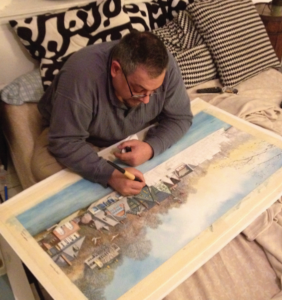
 As communities across the nation celebrate America’s 250th birthday, many are reflecting on the people, places and stories that have shaped our country’s identity. For award-winning artist Nick Santoleri, preserving history has been a lifelong passion. Through paint and pencil, he has spent more than three decades capturing the architecture, landscapes and landmarks that connect generations and remind viewers that the past is never truly gone.
Raised in rural Chester County, Nick developed an early appreciation for the beauty of old buildings and the character they brought to the landscape. Long before he became an internationally recognized artist, he was simply a child fascinated by the stone farmhouses, country roads and colonial architecture that surrounded him. Those scenes left a lasting impression and would later become the foundation of his artistic career. As a youngster, he frequently traveled Goshen Road and formed memories of the streams, bridges and countryside that would one day become recurring subjects in his work.
Today, Nick’s paintings can be found in homes, businesses, universities and public collections throughout the country. Yet despite the national reach of his art, many of his most meaningful pieces remain close to home. For residents in our community, his paintings often evoke more than admiration. They spark memories. His work has immortalized familiar places that generations have passed on their daily travels, transforming ordinary landmarks into treasured pieces of local history.
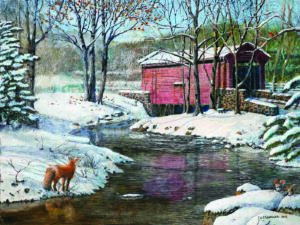
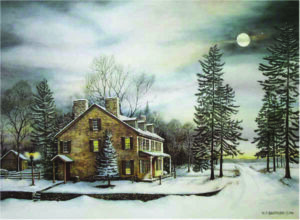 Among his best-known local subjects are the Newtown Square Friends Meeting House and the historic Bartram Covered Bridge. The Meeting House, dating back to 1711, represents the area’s Quaker roots and remains the oldest place of worship in the community. The Bartram Covered Bridge, completed in 1860, is the last covered bridge in Delaware County and stands as a reminder of a simpler era. Through his paintings, Nick has preserved these landmarks in all seasons, allowing viewers to experience them not simply as structures, but as enduring pieces of the community’s story.
Another historic site that has captured his imagination is the Square Tavern, also known as the John West House. Built in 1742, the structure is notable for serving as the boyhood home of Benjamin West, one of America’s first internationally acclaimed painters. The connection between two artists separated by centuries is particularly meaningful. Like West, Nick has dedicated his life to recording the world around him and preserving its stories through art.
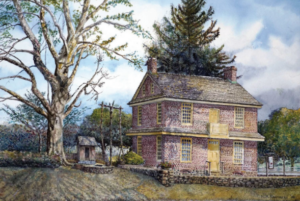 Goshen Road, one of the township’s oldest thoroughfares, has been especially influential in Nick’s work. Established during the colonial era, the road connected early Quaker settlers and became part of the larger story of southeastern Pennsylvania. During the Revolutionary War, soldiers from both the British and Continental armies moved through the surrounding region, making the landscape itself a witness to the birth of a nation.
Years after his childhood travels along Goshen Road, Nick returned to those memories through his paintings. One piece, Pond’s Edge, was inspired by a powerful recollection of a place he had not seen in decades. Upon revisiting the location after completing the painting, he became fascinated by the relationship between memory and reality. “It was fascinating to me how what we remember changes and grows, and how it was similar and different in so many ways,” Nick said.
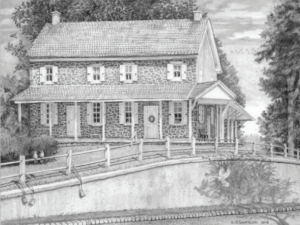 That ability to preserve memories has become one of the defining characteristics of his work. Rather than simply documenting what exists before him, he captures the emotions and experiences attached to a place. His paintings remind viewers that history is not merely dates and events, but the memories people carry with them throughout their lives.
His appreciation for history extends far beyond Delaware County. Philadelphia’s landmarks have occupied a prominent place in his portfolio for decades. He has painted scenes of Independence Hall, Elfreth’s Alley, Boathouse Row and the Philadelphia Museum of Art, returning repeatedly to the sites that helped shape the nation. During this anniversary year, those paintings serve as reminders of Philadelphia’s unique role in American history and the enduring beauty of the places where the country’s founding ideals took root.
Throughout his career, Nick’s artwork has been distributed through galleries across North America and abroad. His paintings and drawings have found homes in universities, hospitals, corporations and private collections. Yet awards and recognition have never overshadowed the personal meaning that art holds for him. “Painting puts me in my own world. It has always been able to calm me down when I’m stressed or nervous,” he said.
 Art has long provided Nick with a sense of peace and reflection. He often compares the creative process to the formation of a pearl. “It’s similar to oysters and pearls,” Nick explained. “An oyster makes a pearl when an irritant, like a grain of sand or rock, gets into it. There is a natural process that makes the irritant smooth and soothes the oyster shell, eventually creating a pearl.”
That philosophy has helped sustain him through life’s challenges and enabled him to create works that resonate deeply with others. Through his long association with the Walden Woods Project, founded by musician Don Henley, Nick’s artwork helped raise more than $100,000 toward preserving the land surrounding Walden Pond, the historic landscape made famous by Henry David Thoreau. His talents have also benefited organizations such as the Salvation Army and Ronald McDonald House, demonstrating that preservation and service often go hand in hand.
Despite decades of success, Nick continues to pursue his craft with the same passion that first inspired him as a child. Through watercolor, oil, pencil and pen and ink, he continues to capture landscapes, architecture and scenes that speak to the passage of time and the beauty of everyday life.
As America marks 250 years of independence, Nick Santoleri’s paintings offer more than beautiful images. They serve as visual time capsules, preserving the places and stories that define communities and connect generations. While historians preserve the past through books and museums, artists preserve it through emotion and imagery.
“Through these acts of personal meditation, I have been able to create works of art and share them with the people of Newtown Square and beyond,” Nick said. In many ways, that is the true gift of his work. Whether depicting a colonial meeting house, a covered bridge or a quiet country road remembered from childhood, Nick Santoleri reminds us that history is not confined to famous battlefields and monuments. It lives in the places we pass every day and in the memories we carry with us. Through every brushstroke, he ensures that those stories will continue to inspire generations
to come.
For more information about Nick Santoleri, please visit his website at Santoleri.com or call 610-529-4648.