
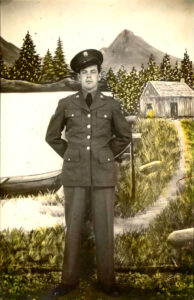
 Newtown Square Friends & Neighbors is proud to feature families, groups and individuals who make a difference in our community. This month, in honor and recognition of the 80th Anniversary of the D-Day Invasion in Normandy, France, during World War II, we highlight and honor the memory of Clifford Douglas Murray, Jr., a Newtown Square resident and member of the 1st Infantry Division, who made the ultimate sacrifice to protect our freedom. Eighty years later, our hometown magazine now posthumously honors a hometown hero, Pvt. Clifford Douglas Murray, Jr. our “2024 Friend & Neighbor of The Year.”
In the early morning hours of June 6, 1944, Clifford and the 224 soldiers of Company L, 16th Regiment, were steaming to their destination: Omaha Beach. They had been living aboard a troop transport ship in Weymouth, England, since June 1st, anxiously awaiting a decision from General Eisenhower, who decided the night before that June 6th would be D-Day. His message to the troops: “You are about to embark upon the Great Crusade, toward which we have striven these many months. The eyes of the world are upon you.”
Company L cruised through the night to the coast of France, and then they transferred into a series of smaller landing craft that could hold 25 soldiers. The Company commander wrote afterward, “One of my landing craft was swamped by the violent seas and sank. To this day, I don’t know how many of those men were lost. Since we were the first combat wave, there was complete silence on the way to the beach. You could hear a pin drop. We didn’t know what to expect when we landed. We soon found out … About a quarter-mile from the beach, all hell broke loose.”
Clifford was a long way from home. He was born and raised in Newtown Square by his father, Clifford Sr., and his mother, Edith May. He had one sister, Elizabeth, and the family lived in a home on the border of Newtown and Marple townships with Clifford and Elizabeth’s grandfather, Maris A. Worrall. Maris was a longtime farm manager at Stull’s Springhill Farm, which was later sold and developed into what we now know as Delaware County Community College, while Clifford, Sr. operated the greenhouse floral business.
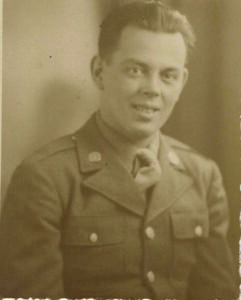 Clifford attended Marple Newtown High School and began working with his father on the farm. He was earning an impressive living at the time, and it is believed that Clifford left high school early to work full-time. On October 16, 1940, Clifford Douglas Murray, Jr. registered for the draft. His draft card describes him as 5’11”, 142 pounds, with brown eyes, black hair and dark complexion. His draft card was signed by the Draft board registrar, local school principal Alice H. Grim.
On December 7, 1941, the Japanese attacked Pearl Harbor. Germany and Japan declared war on the U.S., and young American men flocked to the cause. Clifford enlisted in the Army on February 2, 1942, and shipped out to Fort Meade in Maryland. He was assigned to his 16th Regiment and, by August 1st, was on a transport ship to England. His stay was not long – on October 22nd, they shipped out to Oran, Algeria, and were in constant combat in North Africa through May of 1943. In July of 1943, they had their first taste of amphibian landings as part of the invasion of Sicily and fought their way through the mountains of Sicily. In November of 1943, the 1st Infantry returned to England. The invasion of France was being planned, and the 1st Infantry was in demand – they had combat and invasion experience and were chosen to spearhead the landing in France.
D-Day was the date planned for the invasion of the beaches at Normandy in northern France by troops from the United States, Canada, the United Kingdom and other countries. The amphibious assault—codenamed Operation Overlord—brought together the Allied armies’ land, air and sea forces for what would be the largest invasion in military history.
Adolf Hitler knew of the threat of an invasion along France’s northern coast but did not know exactly where the troops would strike. He directed his best general, Erwin Rommel, to oversee defense operations in the region, which included finishing the Atlantic Wall, a 2,400-mile fortification of bunkers, landmines and beach and water obstacles.
 Company L hit that fortified beach at 7:00 a.m. The Company commander’s report picks up the action: “The landing craft came under an intense attack, including mortar and artillery fire. One of my landing craft took a direct hit from enemy fire as it was unloading onto the beach. Half the men on this craft had already left the boat when it was hit. Some of these men crossed the beach. The remainder were either killed or wounded. As we landed, enemy fire peppered the ramps as they were lowered to allow my men to disembark and cross the 200 yards of open beach. The German pillboxes and machine-gun nests were laying a vicious crossfire on the beach. Many men were cut down as they left the landing craft. Small-arms, mortar, and artillery fire were all concentrated on the landing area, but we suffered our greatest casualties just after touching down because of the crossfire of the German automatic weapons.”
Up and down the beach, men hid behind anything that sheltered them. To stand and move forward would risk drawing the fire of the German machine guns. The invasion was bogging down on the beach. Colonel George A. Taylor, commander of the 16th Regiment, took charge. Standing up on that beach and with a loud voice, he said, “There are two kinds of people who are staying on this beach: those who are dead and those who are going to die. Now, let’s get the hell out of here.” The men began moving forward, crawling through minefields, cutting through barbed wire, and moving steadily on in the face of machine gun fire to the foot of a bluff. Captain Armellino reports, “After reaching the cover of the bluff, I began to reorganize my Company. I had approximately 125 men left of the 200 I started with. I directed my Lieutenants to organize their sections for the start of the attack to knock out the pillboxes and to advance to and capture our objective – Colleville-sur-Mer.”
Normandy was busy that morning. Thousands of paratroopers and glider troops were already on land, behind enemy lines, securing bridges and exit roads. Then, the water invasions began at 6:30 am. British and Canadian forces had little trouble overcoming the opposition to capture beaches codenamed Gold, Juno and Sword, as did the American troops at Utah Beach. However, United States forces were met with intense resistance at Omaha Beach, resulting in over 2,000 American casualties. By the end of the day, over 150,000 Allied troops had successfully stormed Normandy’s beaches, but the sacrifice was significant. Of the 224 men of Company L who left England on June 5th, about 170 re-assembled past the beaches. The other 54 were killed, wounded, or missing.
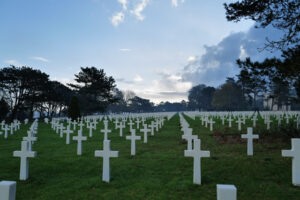
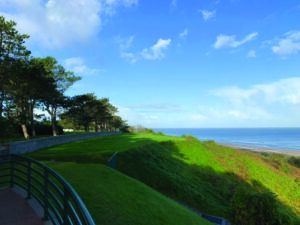
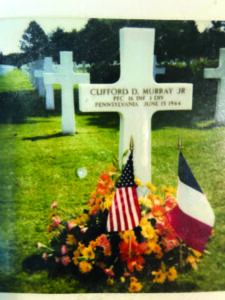 Clifford survived that day. Each day after D-Day, the Allied troops moved forward through a difficult French countryside where each farmer’s field was surrounded by a hedge, giving the defending German troops cover for surprise attacks. The going was slow, and each day, the casualty toll mounted. On June 15th, Clifford and three others were sent in a Jeep to try to make contact with another battalion near La Chapelle. On the return trip, they were strafed by aircraft; two were wounded, and Clifford was killed. He was buried in the cemetery that was hastily created to bury the American and German dead as the invasion swept forward. After the war, these American troops were re-interred in the beautiful Normandy American Cemetery overlooking the beach where Clifford came ashore.
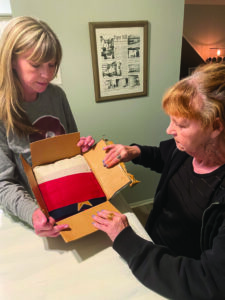
Clifford was awarded the Purple Heart, and the flag that covered his coffin when he was reburied at Normandy was shipped back to his family in Newtown Square. These items, and pictures of Clifford in his new uniform in front of the family home, and overseas in Africa and Italy, newspaper accounts of his death and the death of other area boys, were all put in a box, which rested undisturbed until recently.
In 2023, well before we knew we would honor Clifford in our magazine, Sue and Bob Catlett, who were planning a trip to Normandy, contacted our History Spotlight Expert, Doug Humes. They asked Doug if he knew of any soldiers from our area who had died in the battle.
Sue explained that her father, Bruce FitzGerald, had flown a B17 aircraft in WWII and that the trip she and her husband Bob were taking was through the National WWII Museum’s Masters of the Air tour. “My father served the residents of Marple for over six decades with the Broomall Fire Company, and my mother, Miriam (Hipple) FitzGerald, grew up in the historic Hipple House in Broomall and went to Marple Newtown High School,” Sue explained. “My mother said she remembered growing up with guys who went to war, so I reached out to Doug in the hopes of paying my respects to our local heroes while visiting the American Cemetery in Normandy.”
Doug told Sue that the Marple Newtown area contributed 201 young men who served in the Armed Forces during WWII; of those, six did not return home. Of those six brave soldiers, Clifford Douglas Murray, Jr. was the only one who died during the Normandy Invasion. “I was able to look up where Clifford was buried, locate his plot and place flowers at his cross,” Sue said. “It was a very moving and memorable experience to honor his
memory and service to our country.”
 Sue and Doug noted that 2024 would be the 80th anniversary of D-Day and discussed with publisher Bob Blaisse the idea of doing a feature on Clifford and D-Day. Bob agreed and asked whether Clifford’s family was still living in the area. Doug searched and found that Clifford had a sister who married and had three children. One of those children turned out to be Clifford’s niece, Marion Short. An interview with her followed: “My mother, Elizabeth, was Clifford’s sister,” Marion explained. “My Uncle Clifford died in Normandy when my mother was just three months pregnant with me, so I never got the chance to meet him.” Marion’s daughter Karen, a self-described history buff, explained that she and her mother had boxes of photos, newspaper clippings, and even Clifford’s Purple Heart medal that they would love to share with our community.
Marion said that after Clifford died, her mother and grandmother did not talk about Clifford’s life because it was just too painful. “That generation held a lot in,” she said. “The only thing she would talk about was dropping to the floor when the big black car with the army officer pulled up outside her Line Road home. She immediately knew.” Karen added that although she does not know much about her great-uncle, she is very grateful to have boxes full of memories, including the flag used during Clifford’s burial service.
Many years after Clifford was killed in action, Marion, her sister Janet and brother, Glenn, arranged for their mother, Elizabeth, to travel to Normandy to visit Clifford’s grave. “Janet and her husband, who also served in the military, accompanied Elizabeth on the trip in 1998,” Karen explained. “They paid their respects, toured the grounds and brought back a small container filled with sand from Omaha Beach.” The photos and sand are framed and proudly displayed on a shelf in Karen’s living room.
 For those who have lived in Newtown Square for a fair amount of time, the last name “Short” may ring a bell. That is because Marion’s late husband, Stan Short, a U.S. Marine Corps Veteran, served as Chief of Police in Newtown Township for many years. Stan was also one of the co-founders of the Newtown Square Historical Society. Karen said that even though her father is not here to see this article go to print, she knows he is smiling down from heaven. “My dad worked so hard to preserve and share our town’s history,” she explained. “To now have my great-uncle Clifford’s life and service to our country honored is so very special to our family.”
On behalf of your Newtown Square Friends & Neighbors, we thank Marion and Karen Short for sharing so many special memories of Clifford. The photos, clippings, medals and honors from his life and service are precious memories we are honored to share. And thank you to Sue and Bob Catlett for your thoughtfulness in remembering and honoring our local hometown hero.
We are proud to announce that Clifford Douglas Murray, Jr., who bravely died for his country 80 years ago this month, is our 2024 Newtown Square Friend & Neighbor of The Year, posthumously recognized in service to his community once again, to represent all Marple, Newtown, and Edgmont soldiers from our area, who served the WWII cause of freedom with the ultimate sacrifice of being killed in action for that noble cause.
On this 80th Anniversary of D-Day, let us remember that the bedrock of each celebration is our freedom and the men and women who fought and gave their lives for that freedom. “Poor is the nation that has no heroes, but poorer still is the nation that, having heroes, fails to remember and honor them.” ~Cicero
Do you know a Newtown Square family, individual or nonprofit group who should become known by our community? Make your nominations for
upcoming feature articles by emailing your ideas to Sheila Turner-Hilliard at STurnerHilliard@BestVersionMedia.com.