
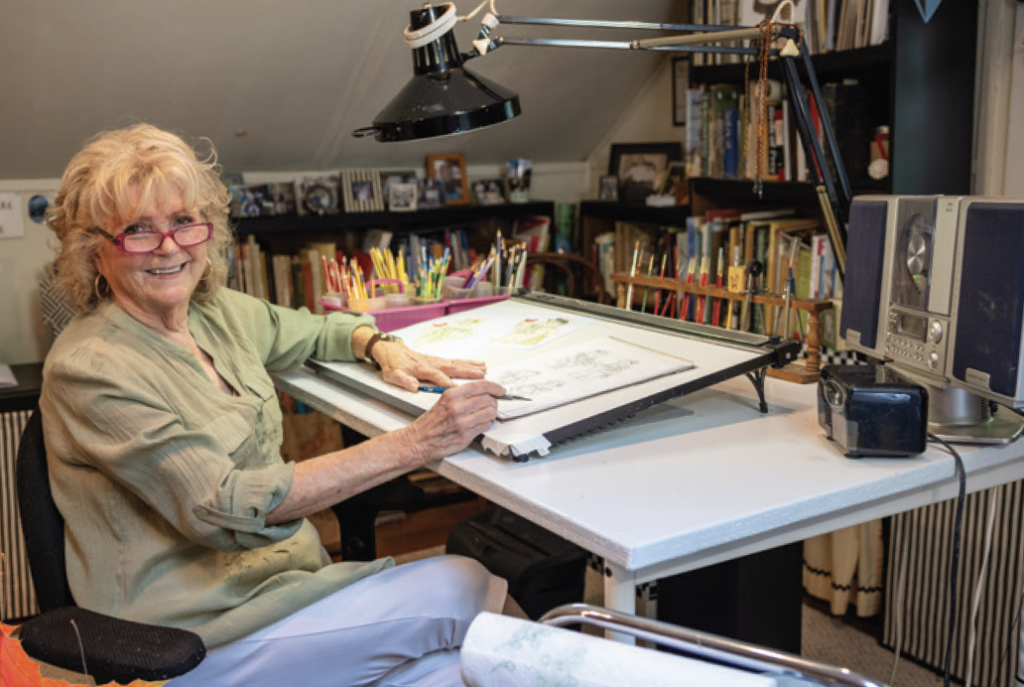
Your Newtown Square Friends & Neighbors magazine’s mission of Bringing People Together often shines the spotlight on families and individuals who make a difference in our community and beyond. This month, we are proud to introduce you to Terry Jones and Maggie Murphy-Jones: a couple who designs and sculpts meaningful moments for themselves in Newtown Square while sharing their passions and projects with others around the globe.
If you haven’t heard about Terry Jones, you’ve likely seen his work at some of our iconic historical sites. He is a world-renowned sculptor whose monuments include an eight-foot bronze statue of Union General John Gibbon in Gettysburg, PA, the Lt. Gen. Lewis B. “Chesty” Puller statue at the National Museum of the Marine Corps in Quantico, VA and the Mariners’ Monument comprised of four life-size bronze statues and a 3′ x 5′ relief plaque all mounted on 49 tons of Vermont granite at the US Merchant Marine Academy in Kings Point, NY.
Those are just a few of Terry’s works that he designs and sculpts right here from his home studio in Newtown Square. It’s an artist’s paradise tucked away in a serene setting perfect for designing, creating and sculpting some of our nation’s national treasures. It’s a home he shares with his wife, Maggie, who is a successful illustrator and designer who also spends time photographing and documenting Terry’s sculptures from conception to dedication.
Terry said that he has always loved history and art. “Back when I was in high school, I would borrow history books from the library and spent much of my time drawing in my notebooks,” he said. “But I was also very interested in archeology and wanted to travel the world.” Terry explained that when he was a junior in high school, his mother asked him what he wanted to do after graduation. He told her he wanted to study archeology but found that the best college program in that field was financially out of reach. She then asked him if he had any other interests, to which he said he wanted to study art.
“Unfortunately, the Catholic high school I attended in Chester didn’t have an art program,” Terry explained. “So, my mother suggested that I enroll at Ridley Township High School for my Senior year.” While Terry wasn’t too happy about switching schools so late, he worked hard to catch up and created a portfolio he submitted to several area colleges. “There were 10 of us from Ridley who were applying to art schools,” he said. “Nine of the ten were accepted – I was the tenth.”
Rejection didn’t deter Terry, however. He immediately returned to the “drawing board” and created an entirely new portfolio. He undoubtedly had talent, but his grit and determination impressed admissions directors and ultimately earned him acceptance to the Hussian School of Art in Philadelphia. Terry studied there before enlisting and serving in the United States Marine Corps Reserves.
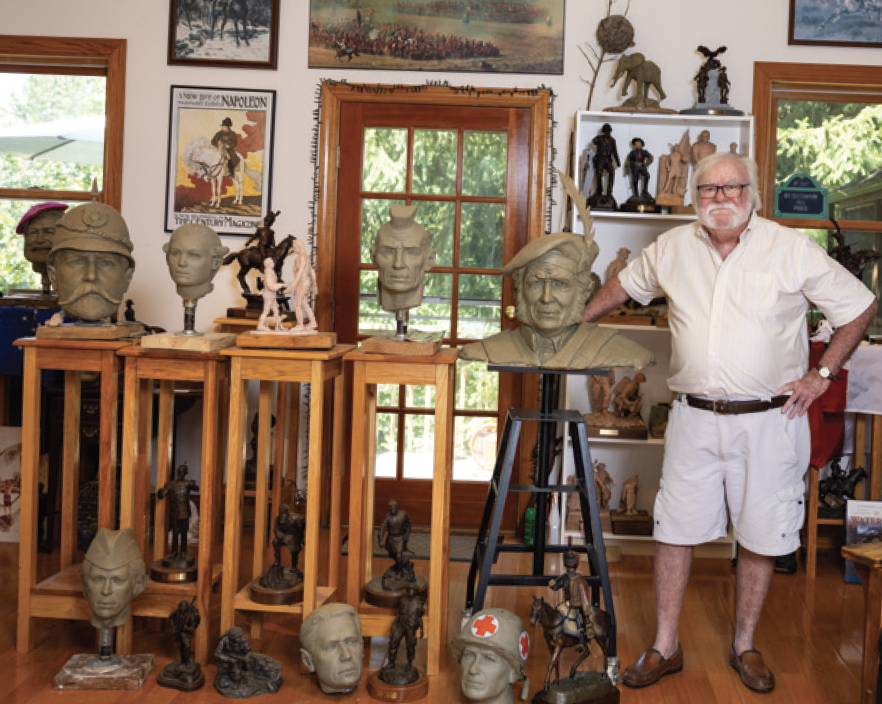
Terry began his career as an artist, creating artwork for a furniture company who advertised in the Philadelphia Evening Bulletin. He then embraced an opportunity to start his sculpting career at the former Franklin Mint, developing 600 bas-relief (pronounced bah-relief) medals and coins. Sculpting in bas-relief starts with a flat plaster base onto which the artist “draws” an image in clay in very low layers, measured in millimeters, until the depiction of the future coin is complete. An impression of dimension is created, but remains almost flat, like any of the coins we might have in our pockets. During his time at the Mint, Terry had the opportunity to take a sabbatical and was accepted at the École des Beaux-Arts in Paris for a semester studying sculpture in France. “I was with the Franklin Mint for 16 years,” Terry said. “My time there served me well, and it was where I met my wife, Maggie, but I always knew I wanted to go out on my own.”
Terry moved from bas-relief to creating figures “in the round.” He coupled that with his love for history by designing and sculpting figures from our past. “I study each individual thoroughly because I need to accurately capture their personality, mannerisms and expressions,” he explained. “It is my responsibility to tell their story and my legacy that my bronzes will exist for centuries – with my name on them.”
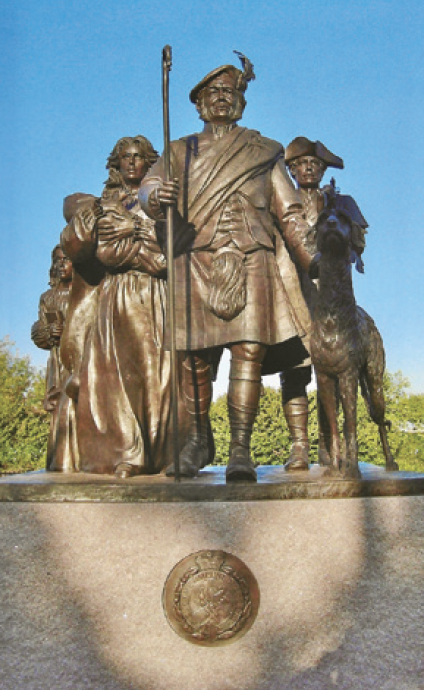
Memorial, Front &
Sansom Sts, Philadelphia Photos courtesy of Terry Jones
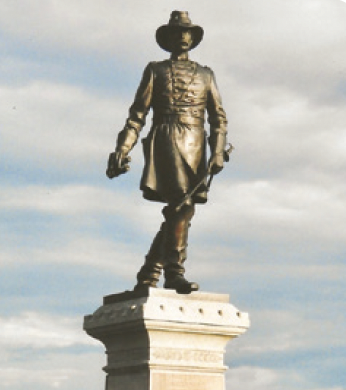
Gettysburg Battlefield
You need three things for a monument to happen: a site, funding and passion. Before beginning a commission, Terry crafts a small model so those who commissioned the work can approve the design before the major work begins. The next step is enlarging the small model to the full height of the actual statue in clay, in his studio, usually with the use of suited-up models. When Terry is finally satisfied with his sculpture, a crew from the Laran Bronze Foundry from Chester PA arrives to transport the clay sculpture to the foundry for the very complicated casting process, which takes about 12 weeks. The steps involve molds, wax, ceramic shell, melting out the wax (lost wax), pouring the molten bronze, cleaning and reassembling the statue and finally applying a patina.
Terry said that bringing a sculpture to life is a team effort and credits both the foundry and his wife, Maggie, for his success. “Maggie is a talented illustrator who helps me take my original sketches to another level,” he said. “She helps me fine-tune every detail before I begin working on the model.” Maggie also makes sure that the entire process is memorialized for years to come. “I take photos of every step of the process,” she said proudly. “Each of Terry’s monuments has a dedicated photo album complete with captions and copies of every news article printed.”
Most days, while Terry is busy sculpting in his home studio, Maggie is working diligently in her own studio space on the second floor of their home. “I have been very fortunate to have been employed continuously as an illustrator and designer since the day I graduated from Moore College of Art and Design, where I earned my BFA in Illustration,” she said. Early in her career, Maggie worked for McGraw-Hill’s educational division creating artwork for books, posters, games and other classroom materials.
After a few successful years, Maggie decided to become a freelance artist and began working for the former Franklin Mint. “I designed giftware for production in porcelain, metal, crystal and resin,” she explained. “I created designs for figurines, ornaments, dolls and many more collectibles.” Maggie also began accepting assignments from The Danbury Mint, The Bradford Group, Avon and The Hamilton Exchange. Most of her work over the past 25 years has been for Lenox, Inc.
It would be pretty tough to find a household in Newtown Square, or the United States for that matter, that doesn’t have a cherished piece or two of Lenox on their shelf, so it’s pretty amazing to know that many of you have something that Maggie Murphy-Jones designed. “I designed all nine of Lenox’s Nursery Sets, which included a cup, bowl, spoon, fork and frames,” she said. “I also designed most of Lenox’s Happy Holly Days porcelain giftware line, including lighted figures, serving pieces and cookie jars.” Maggie said that Lenox always sends her a sample of the finished product once her designs are brought to life. “Our guest room is filled with figurines that make it a special place for our two granddaughters when they stay with us,” she said. “I also love to give some of my work to family and friends.”
These days, Maggie is designing a new collection of Lenox ornaments and over the years, has completed children’s themed murals. Maggie also continues to expand her knowledge of art by taking botanical illustration classes at Longwood Gardens, Chanticleer and Main Line School Night.
Terry continues his love of history and art by having participated in scores of battle re-enactments and historical events. He has studied the life of Benjamin West (1738-1820) extensively and can often be found at the Square Tavern in Newtown Square and at various Newtown Township events to present an in-depth look at the artist who began his career at the Square Tavern in Newtown Square and went on to be known as the Father of American painting. West spent his childhood years at the Square Tavern, where his father worked. His art caught the attention of many supportive individuals who sent him to study in Italy. He then established a studio in London, was selected as a court painter to King George III, and became one of the founders of the Royal Academy of the Arts in London; he is buried at St. Paul’s Cathedral there.
Benjamin West was passionate about teaching young painters. He opened his studio and his home to students from America who wanted to further their art education. “Like Benjamin West, I, too, am passionate about the arts at the forefront in schools,” Terry said. “Young people have to realize they can make a contribution through the arts.”
Fortunately for us, many members of our community support Terry’s mission and recognize the importance of keeping the arts and history alive. “I am very excited to announce that I am in the process of designing a monument of Benjamin West that will be located on the grounds of the Ellis Preserve,” Terry remarked. “The project has received a pledge of a generous donation from Stephen Spaeder, Principal and Senior Vice President of Equus Capital Partners, Ltd. We look forward to continuing our fundraising campaign this fall.”
Whether it’s completing a life-size bronze statue of a decorated soldier or designing a piece of Lenox porcelain that becomes a family heirloom, both Maggie and Terry appreciate their talents’ impact on those around them. “We are very lucky to continue to be so passionate about our work after all these years,” they said. To learn more about Terry’s work, visit his website at www.TerryJonesSculpture.com.
Do you know a Newtown Square family, individual or nonprofit group who should become known by our community? Make your nominations for upcoming feature articles by emailing your ideas to Sheila Turner-Hilliard at STurnerHilliard@BestVersionMedia.com.